
Imagination to Impact
Insights for Creatives from MIT’s
AI & Machine Learning Program
Last January, I enrolled in the MIT's Artificial Intelligence & Machine Learning program and experienced a tsunami of information that was both overwhelming and strangely familiar. MIT might seem like a counter-intuitive place for a creative professional to land, but after using ChatGPT, Perplexity and Midjourney, I wanted to know just how the whole thing worked. What are the actual mechanics of AI and ML? In what ways could it add value to my career? As the only creative in a cohort of data scientists, I approached the material from a completely different perspective than my classmates.
The first step on the journey was getting a firm grasp on the underlying principles of AI – and that meant learning basic calculus. MIT assumes you have an inkling about calculus - a subject I successfully dodged in high school. I couldn’t tell a cosine from a stop sign. Luckily, I discovered Professor Woo’s excellent calculus class on YouTube and binged an entire semester.
The MIT program is divided into 12 individual courses, leading off with the History of Computing and continuing with such dynamic subjects as Structured and Unstructured Data, Temporal Analysis, Predictive Analytics, Computer Vision Methods, and Prompt Engineering. What I came away with, is that Artificial Intelligence provides artists, across all media, with a truly unlimited canvas.
Humans and AI are a beautiful partnership, a symbiotic relationship, the more advanced the technology, the more valuable the human factor. Humans ensure the final product maintains its authenticity, emotional depth and connectivity/resonance that purely AI-generated content lacks. AI systems are based on artificial neural networks, inspired and engineered by how the human brain functions.
Machine Learning and Neural Networks
AI models use machine learning algorithms (mathematical equations) to acquire, absorb and validate knowledge from inputs to improve their performance and make decisions. The information flows through “hidden layers” - webs of connected digital neurons - where the magic happens. These artificial neurons contain “transformers”, sophisticated algorithms that evaluate and calculate the input, creating trainable “parameters” that educate the AI to capture complex relationships within the data, which then form its decision-making abilities to activate the output.
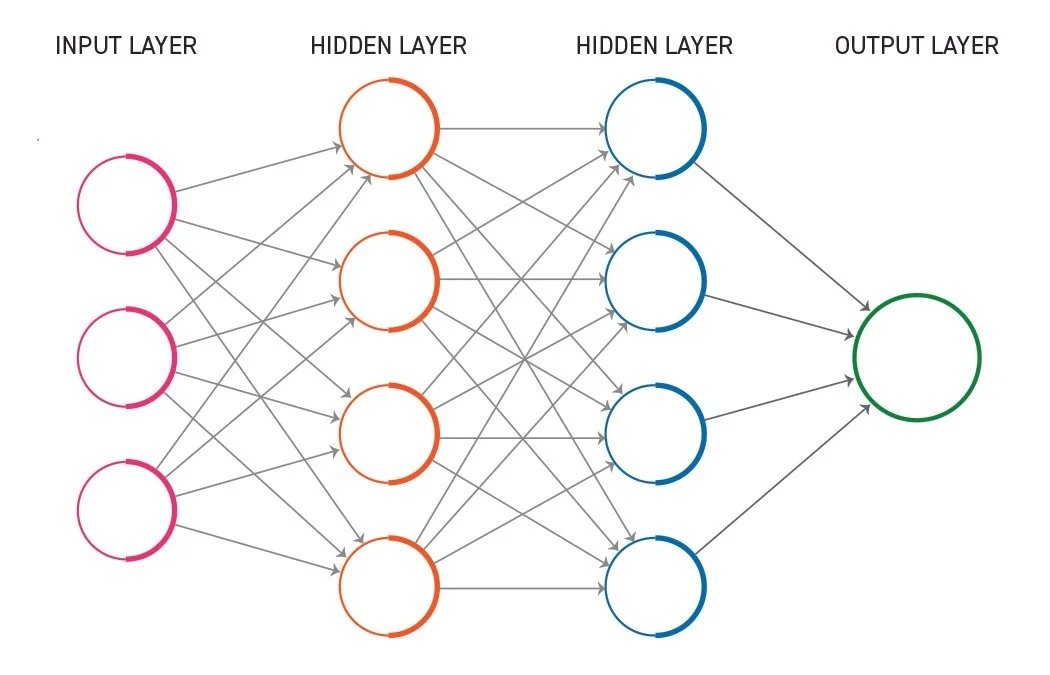
Simplified Neural Network showcasing data flow from input through hidden layers composed of transformer nodes containing mathematical algorithms.
Machine Learning is like a detective unraveling a mystery with only partial clues, aiming to predict the unknown based on existing knowledge. These digital detectives deduce and process information, adjusting their understanding of the input. The outcome is an impressive ability to predict what comes next, just like the suggested text that's generated when you're typing a message – except instead of a friend finishing your sentence - it’s a machine doing the predicting. This multi-layered approach enables AI to develop a recognition of data, transforming raw information into meaningful insights until a complete story emerges.
It’s important to remember that Generative AI's knowledge is limited to its training data. If the input or reference data is incomplete or inaccurate, the output may be incorrect or misleading. While these models analyze patterns and correlations within their training data, they don't continuously learn from new interactions. Instead, they require careful fine-tuning and testing before deployment. Despite their impressive capabilities, generative AI models can produce “hallucinations” or biased content, and lack true understanding of the information they process. Human oversight and fact-checking remain essential steps in the process.
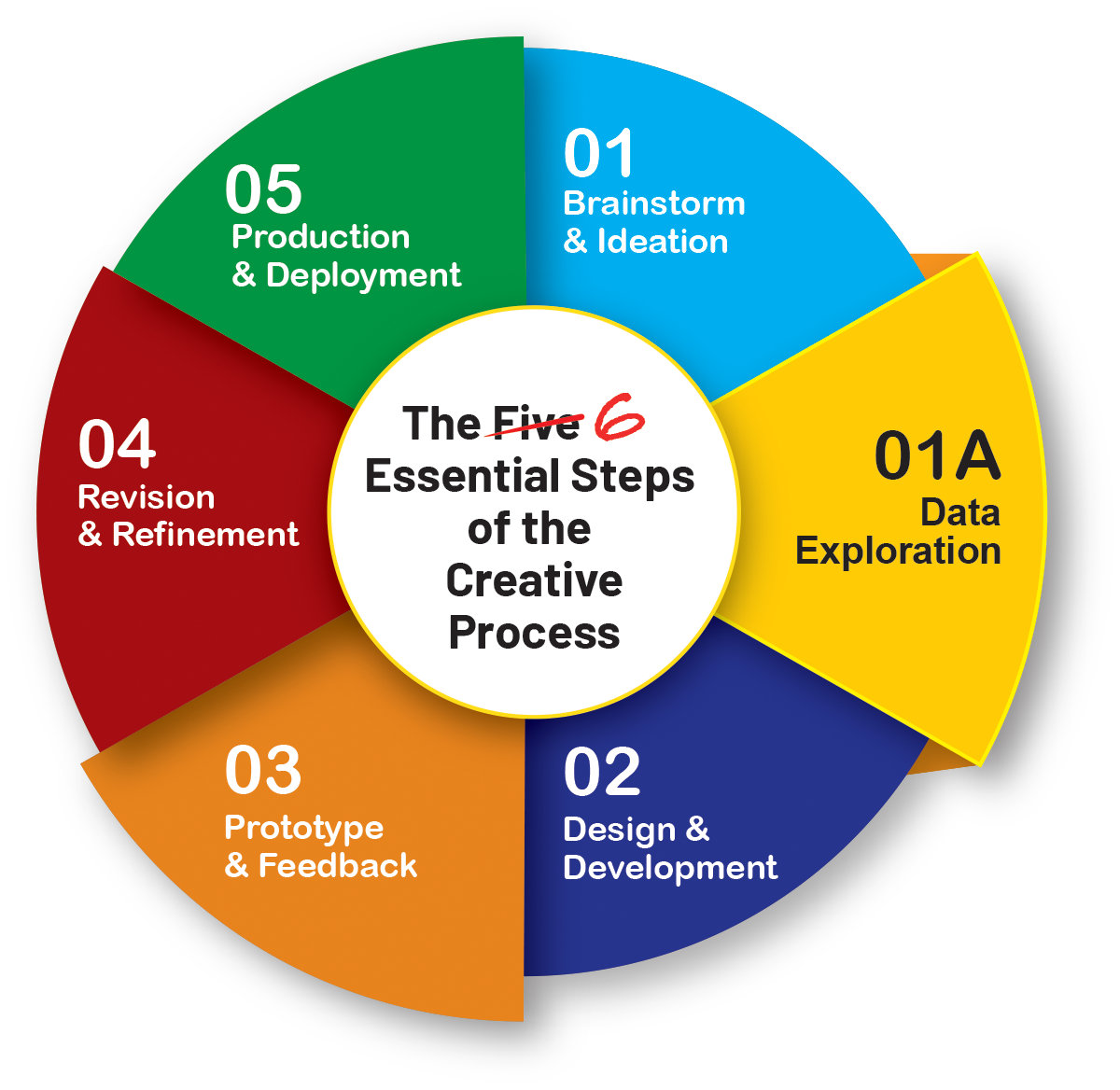
Adding Data Exploration to the traditional 5 steps of creative production to enhance the narrative.
Data Mining the Creative Narrative
I was introduced to several data science applications (RapidMiner, Dataiku and Knime), that empower users with insights into valuable analytics, utilizing Gen AI models without having to write a stitch of code. My immediate takeaway was that these are resources creative leaders should plan to incorporate in their kit to build effective narratives that resonate with their intended audience. Three tracks of data exploration stand out:
Predictive Analytics: While not traditionally considered a "creative" technology, predictive analytics is taking an increasingly important role. For example, in product design, AI analyzes social media, consumer behavior, and other data sources to predict upcoming trends, allowing for more strategic campaign planning and on-target design.
Audience Insights: Applications like RapidMiner Studio can help analyze audience data. Using clustering and classification algorithms, creatives can segment their audience data to better understand different groups within their target market.
Sentiment Analysis: A metric used to gauge audience reactions to creative works, helping creators understand how their content is being received. Machine learning algorithms can analyze user behavior and preferences to effectively categorize and provide accurate personalized recommendations. Streaming platforms recommend content via surveys and by reviewing a consumer's patterns.
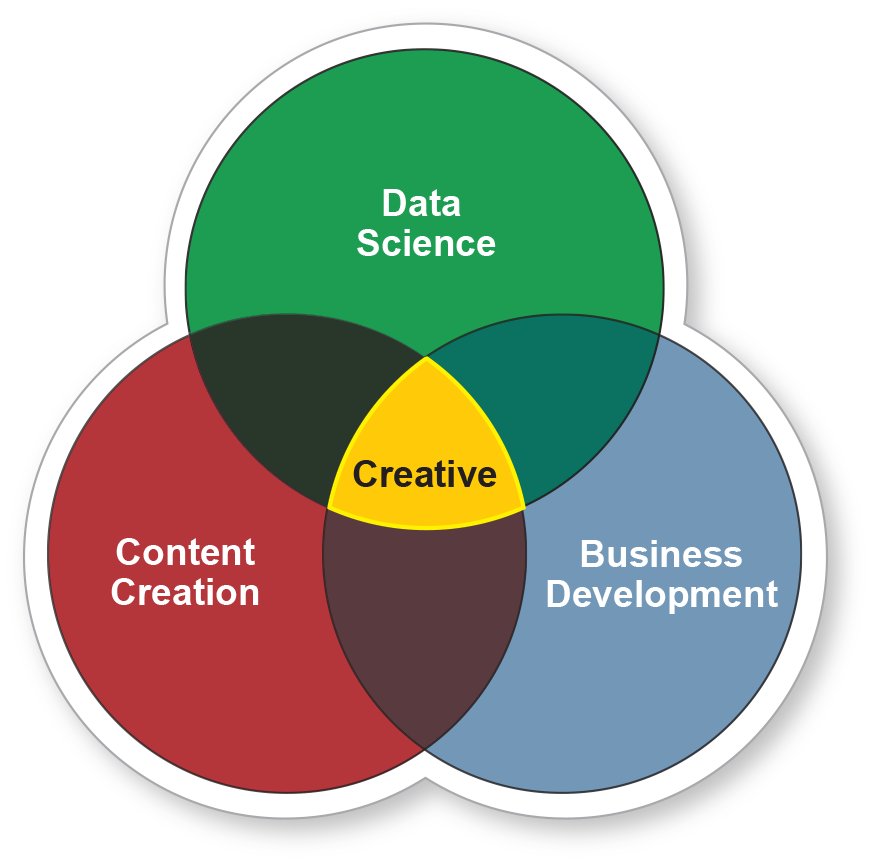
Informed creative is a core component of reaching your intended audience.
In this technological renaissance, it all comes back to the human element. Artificial Intelligence is unable to generate authenticity. AI is an active agent to enhance your ideas, and while Generative AI can create, it doesn't understand culture and nuance. AI doesn’t feel or have empathy. The potential for an over-reliance on AI can lead to generic content that lacks originality or feels too similar to other AI generated work. Always try to weave in personal anecdotes, emotional elements and insights that only a living, breathing human can provide. Additionally, when working in concert with AI, review and edit output to ensure accuracy, tone, and alignment with your brand. Learn to dance with the algorithms to define your voice.
The MIT AI and Machine Learning program introduced me to new pathways for creative and business development. The key is not to view AI as a replacement, but as a dynamic partner. It's like having a super-powered assistant, augmenting creativity and enabling us to work more efficiently, with greater innovation, impact and unprecedented value.